Instrumentation
1. Transducers with Charge Output
Transducers
with charge output have some special properties which require
particular attention in order to obtain precise measuring results:
- Always use special low
noise cables.
- The cable length must not exceed 10 meters.
- The cable should not be moved during measurement.
- All connector nuts must be tightened.
Preferably charge amplifiers should be used. It is also
possible to use
AC voltage amplifiers with high impedance input. Both principles are
described below.
1.1 Charge Amplifiers
Accelerometers with charge output generate an output signal in
the range of some picocoulombs (1 pC = 1000 fC)
with a very high impedance. To process this signal by standard AC
measuring equipment it needs to be transformed into a low impedance
voltage signal.
Preferably, charge amplifiers are used for this purpose. The
input stage of a charge amplifier features a capacitive feedback
circuit which balances the effect of the applied charge input signal.
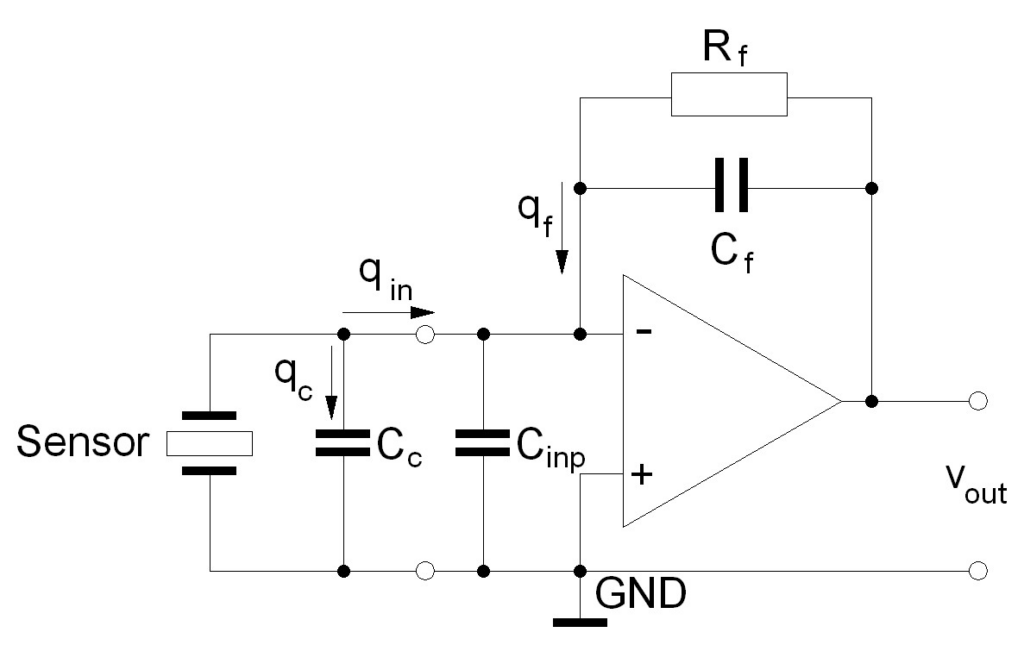
The feedback signal is then a measure of input charge. Figure 10 shows
a typical charge input stage.

Figure 10: Charge amplifier
The input charge qin is applied to
the summing point (inverting input) of the amplifier. It is distributed
to the cable capacitance Cc, the amplifier
input capacitance Cinp and the feedback
capacitor Cf. The node equation of the input
is therefore:

Using the electrostatic equation:

and substituting qc, qinp
and qf :

Since the voltage difference between the inverting and the
non-inverting input of a differential amplifier becomes zero under
normal operating conditions, we can assume that the input voltage of
the charge amplifier uinp will be equal to GND potential. With uinp = 0
we may simplify the equation:

and solving for the output voltage uout:

The result clearly shows that the output voltage of a
charge amplifier depends only on the charge input and the feedback
capacitance. Input and cable capacitances have no influence on the
output signal. This is a significant fact when measuring with different
cable lengths and types.
Referring to Figure 10, the feedback resistor Rf has the
function to provide DC stability to the circuit and to define the lower
frequency limit of the amplifier. The circuit in Figure 10 represents
only the input stage of a charge amplifier. Other stages like voltage
amplifiers, buffers filters and integrators are not shown.
Typical charge amplifiers are, for example, the M68 series Signal Conditioners
and the IEPE100 Remote Charge Converters made by Metra.
Instead of charge amplifiers,
high impedance voltage
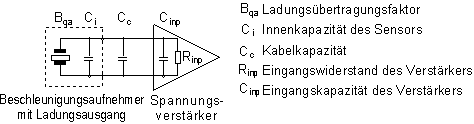
amplifiers can be used with charge mode transducers. In this case,
however, the capacitances of sensor, cable, and amplifier input must be
considered (Figure 11).

Figure 11: Charge mode sensor at
voltage amplifier
The voltage sensitivity of an
accelerometer with known charge
sensitivity Bqa and inner capacitance Ci
is calculated to:

Bqa and
Ci
can be found in the sensor data sheet.
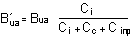
Taking into account the
capacitance of the sensor cable Cc
and the input capacitance Cinp of the voltage
amplifier, the resulting voltage sensitivity B´ua
will become lower than Bua:

A typical 1.5 m low noise
cable Model 009 has a capacitance
of approximately
135 pF.
The lower frequency limit fl will also be influenced by Cc,
Cinp and Rinp:
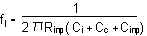
The lower frequency limit increases with decreasing input
resistance.
Example: A charge mode accelerometer Model KS56 with inner
capacitance Ci = 370 pF is connected to
a typical scope input with Rinp = 10 MOhms
and Cinp = 20 pF. The sensor cable
has a capacitance of 135 pF.
Result: The lower frequency limit will be at about 30 Hz.
A special feature of IEPE
compatible transducers is that
power supply and measuring signal are transmitted via the same cable.
So, an IEPE compatible transducer requires, like a transducer with
charge output, only one single-ended shielded cable.
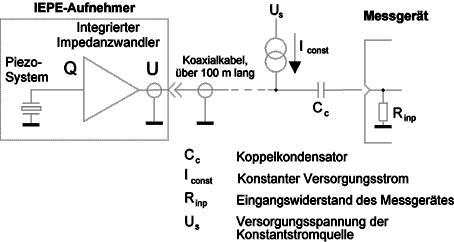
Figure 12 shows the principle circuit diagram.

Figure 12: IEPE principle
The integrated sensor electronics is powered with constant
current in the range between 2 and 20 mA. A typical value is
4 mA. Some battery powered instruments even work at 1 mA. The
constant current Iconst is fed into the signal cable of the sensor. The
supply current and the length of the cable may influence the upper
frequency limit.
The de-coupling capacitor Cc keeps
DC components away from the signal conditioning circuit. The
combination of Cc and Rinp
acts as a high pass filter. Its time constant should be sufficiently
high to let all relevant low frequency components of the sensor signal
pass.
Important:
- Do not apply a voltage source without constant current
regulation s to an IEPE transducer.
- False polarization of the sensor cable may immediately
destroy the built-in electronics.
In Figure 13 can be seen that IEPE compatible transducers
provide an intrinsic self-test feature. By means of the bias voltage at
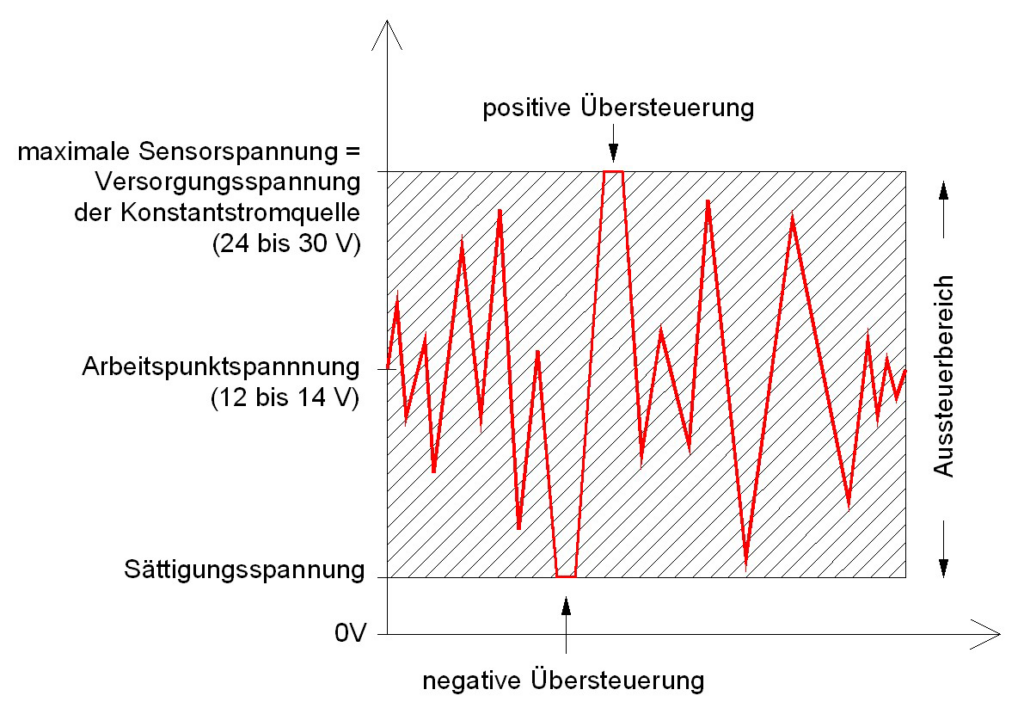
the input of the instrument the following operating conditions can be
detected:

Figure 13: Dynamic range of IEPE compatible accelerometers
In Figure 13 can be seen that IEPE compatible transducers
provide an intrinsic self-test feature. By means of the bias voltage at
the input of the instrument the following operating conditions can be
detected:
- UBIAS < 0.5 to 1
V: short-circuit or negative overload
- 1 V < UBIAS < 18 V: O.K., output
within the proper range
- UBIAS > 18
V:
positive overload or input open (cable broken or not connected)
A variety of instruments are equipped with a constant current
sensor supply. Examples from Metra are the Signal Conditioners of M68 series, M208 and M32, the Vibration Monitor M12 or the Vibration Calibrating
System VC110. The
constant current source may also be a separate unit, for example Model M28.
3.1 Introduction
The standard IEEE 1451complies with the increasing importance
of digital data acquisition systems. IEEE 1451 mainly defines the
protocol and network structure for sensors with fully digital output.
Part IEEE 1451.4, however, deals with "Mixed Mode Sensors", which have
a conventional IEPE compatible output,
but contain in addition a memory for an "Electronic Data Sheet". This
data storage is named "TEDS" (Transducer Electronic Data Sheet). The
memory of 64 + 256 bits contains all important technical data which are of
interest for the user. Due to the restrictions of memory size the data is packed in different coding formats.
The Transducer Electronic Data Sheet provides several
advantages:
- When measuring at many measuring points it will make it
easier to identify the different sensors as belonging to a particular
input. It is not necessary to mark and track the cable, which takes up
a great deal of time.
- The measuring system reads the calibration data
automatically. Till now it was necessary to have a data base with the
technical specification of the used transducers, like serial number,
measured quantity, sensitivity etc.
- The sensor self-identification allows to change a
transducer with a minimum of time and work ("Plug & Play").
- The data sheet of a transducer is a document which often
gets lost. The so called TEDS sensor contains all necessary technical
specification. Therefore, you are able to execute the measurement, even
if the data sheet is just not at hand.
- The standard IEEE 1451.4 is based on the IEPE standard.
Therefore, TEDS transducers can be used like common IEPE transducers.
Figure 14 shows the principle of TEDS.

Figure 14: Accelerometer with TEDS to IEEE 1451.4
If a constant current source is applied, the sensor will act
like a normal IEPE compatible sensor.
Programming and reading the built-in non-volatile 64 + 256 Bit memory DS2430
is also done via the sensor cable. The communication uses Maxim’s 1-Wire®
protocol (www.ibutton.com).
For data exchange TTL level with negative polarity is used. This makes
it possible to separate analog and digital signals inside the sensor by
two simple diodes.
Metra's 8-channel IEPE signal conditioner M208A provides full TEDS
support with automatic transducer sensitivity normalization.
3.2 Sensor Data in TEDS Memory
3.2.1 Basic TEDS
A 64 bit portion of the memory is called application
register. It includes the so-called Basic TEDS with general information
to identify the sensor:
- Model and version number: Metra stores in this location a
coded model number. The actual model number, for example "KS78.100",
can be decoded by means of a *.xdl file to IEEE 1451.4 standard,
the so-called "Manufacturer Model
Enumeration File" which can be found in the download section of our web pages.
- Serial number: This is the actual serial number of the sensor which can be found on its case.
- Manufacturer code: A manufacturer-specific number assigned
by IEEE. Metra's manufacturer number is 61. A complete list of
manufacturer codes can be found here: http://standards.ieee.org/develop/regauth/manid/public.html
Basic TEDS can exclusively be modified and stored by the manufacturer.
3.2.2 Template No. 25
Calibration data is stored in a 256 byte section. The arrangement of
the data is defined in TEDS templates. For accelerometers in most cases
the standard template no. 25 will be applied. Some switch bits
determine whether the memory includes a transfer function or not. Metra
stores, if no other format is desired by the customer, the version with
transfer function including data like resonance or lower frequency
limit.
Template no. 25 includes the following data:
- Sensitivity in V/m/s²: Sensitivity value at reference conditions according to the supplied calibration chart
- Calibration frequency of sensitivity in Hz
- Lower frequency limit in Hz: Typical value according to sensor data sheet
- Measuring direction: Relevant for triaxial accelerometers (0 = X; 1 = Y; 2 = Z; 3 = no data)
- Sensor weight in grams
- Polarity of output signal for positive acceleration: 0 = positive, 1 = negative
- Low pass frequency in Hz (if the sensor includes a low pass filter)
- Resonance frequency in Hz: Typical value according to sensor data sheet
- Amplitude slope in percent per decade
- Temperature coefficient in percent per Kelvin: Typical value according to sensor data sheet
- Calibration date (DD.MM.YY)
- Initials of calibrating person (3 capital letters)
- Calibration interval in days: Recommended time until next calibration
This data can be modified by the calibration lab of the manufacturer or later by other calibration labs.
In addition, TEDS memory provides some bytes for application specific data which may be entered by the user:
- Measurement point ID (1 to 2046)
- User text: 13 characters
Notice: In our Download section we offer a TEDS editor which can be used to read or modify the data stored in TEDS transducers.
Please click for details
Reference: IEEE 1451 Working Group
Proceed to chapter Accelerometer Selection
|