Manfred Weber  

Metra Mess- und Frequenztechnik in Radebeul e.K.    

Since 1954  


Accelerometer Mounting

Home


Vibration  Transducers


Signal Conditioners


Vibration Calibrators


Machine Monitoring


Human Vibration


PC Data Acquisition


Cables and Accessories


Special Products


Theory and Standards

Introduction

Piezoelectric Principle

Accelerometer Designs

IEPE Standard

Characteristics

Instrumentation

Accelerometer Selection

Accelerometer Mounting

Accelerometer Cabling

Accuracy and Calibration

Standards


Product Literature


Software Download


Contact Us


Representatives


About Us


News


For Distributors


Choosing the optimum mounting arrangement will significantly improve the accuracy.

For best performance, particularly at high frequencies, the accelerometer base and the test object should have clean, flat, smooth, unscratched and burr-free surfaces.

A scratched accelerometer base can be applied to a lapping plate for restoration of flatness. If lapping is not possible, other machining processes such as grinding, spotfacing, milling, turning, etc., can produce acceptably flat mounting surfaces.

It is also important to provide a stiff mechanical connection between the sensor and the source of vibration. Sheet metal or plastic parts and other thin and flexible components are unsuited for accelerometer mounting.
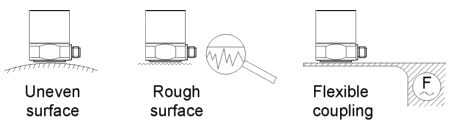
Coupling errors

Figure 15: Typical reasons of coupling errors

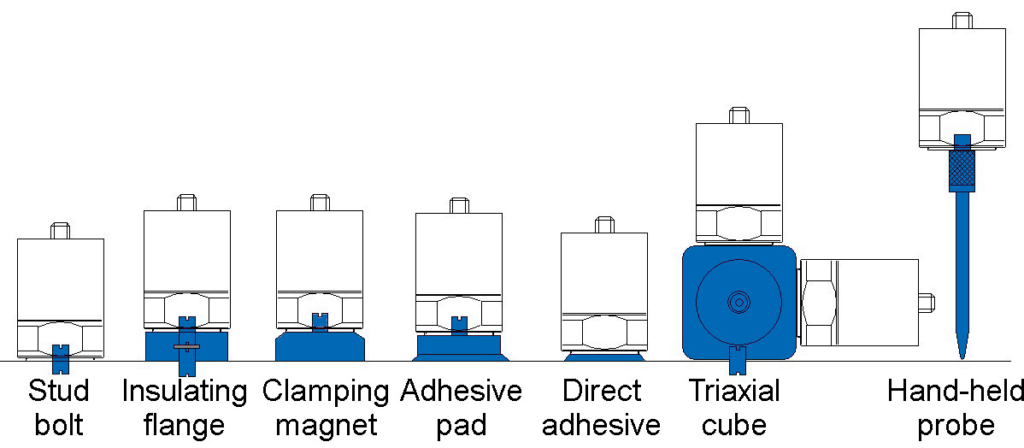
The following mounting methods are recommended for accelerometers:

Mounting methods

Figure 16: Mounting methods for accelerometers

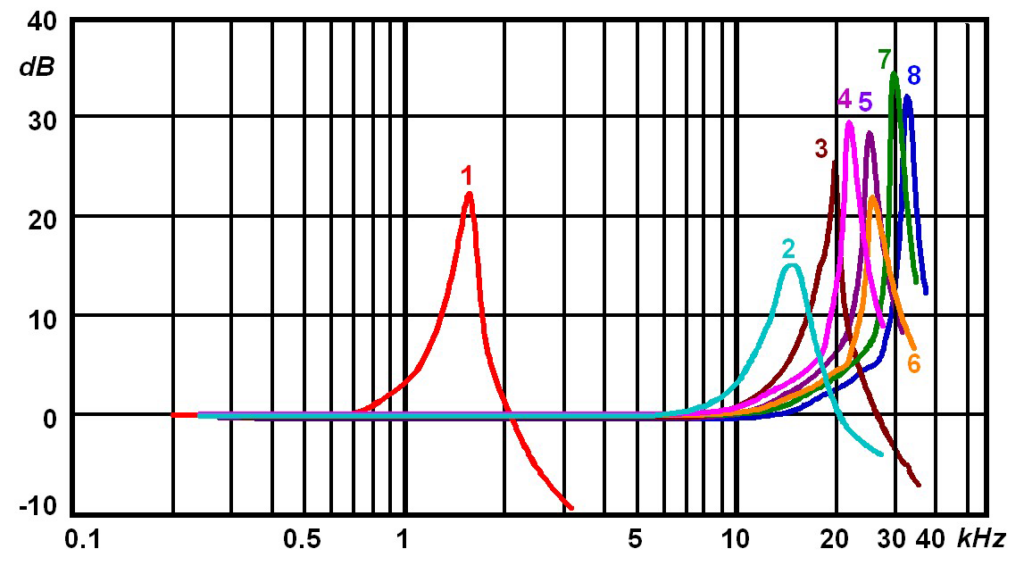
Figure 17 compares the typical high frequency performance of some mounting methods as a result of added mass and reduced mounting stiffness.

Coupling resonances

a Accelerometer probe

b Insulating flange

c Magnetic clamp

d Adhesive mounting (no wax)

e Stud mounting


Figure 17: Resonance frequencies of different mounting methods

Metra accelerometers may have the mounting thread sizes: M3, M5, M8 and M10.

Many transducers are available with an accessory kit (ordering option "/01") containing all suitable mounting parts.

The following table shows the available mounting accessories from Metra:


Mounting Part

  Suitability

Stud Bolts

021 (M3)
003 (M5)
043 (M8)

022 (M3 auf M5)

044 (M5 auf M8)
045 (M5 auf 10-32)

046 (M5 auf ¼"-28)

  • For best performance.

  • For permanent mounting.

  • Tapped hole in test object required.

  • A thin layer of silicon grease between mating surfaces aids in the fidelity of vibration transmission.

  • Recommended torque: 1 Nm.

  • Make sure that the mounting stud is not too long resulting in a gap between sensor and test object.

Insulating Flanges

106 (2 x M3)

006 (2 x M5)

206 (2 x M8)

129 (M3, small, adhesive)

329 (M3, large, adhesive)

029 (M5, adhesive)

  • Avoid ground loops. 

  • Limited performance at high frequencies.

  • Model 006 not suited for temperatures above 100 °C.

Back to top

Mounting Pads

129 (M3, small)

329 (M3, large)

029 (M5)

229 (M8)

  • Adhesive attachment using cyanoacrylate, epoxy glue or dental cement.

  • For applications where drilling is not allowed or possible.

  • Models 029, 129 and 329 provide isolation against ground loops. 

Magnetic Clamps

108 (M3, small)

308 (M3, large)

408 (M4 tap)

008 (M5)

208 (M8)


  • For rapid mounting with limited high frequency performance.

  • Ferromagnetic object with smooth and flat surface required.

  • If not available, weld or epoxy a steel mounting pad to the test surface.

  • Important: Don’t drop the magnet onto the test object to protect the sensor from shock acceleration. Gently slide the sensor with the magnet to the place.

  • Do not use magnets for seismic accelerometers (risk of overload).

Triaxial Mounting Cubes

130 (M3)

030 (M5)

230 (M8)

330 (M10)

  • For triaxial measurements with three uniaxial accelerometers


Handle adapter

140

  • For the attachment of accelerometers with M3 thread on curved surfaces

Accelerometer Probe

001 (M5)


  • For estimating and trending measurements above 5 Hz and below 1000 Hz.

  • Attach the accelerometer via the M5 thread.

  • Press onto the test object perpendicularly.

  • Drilling a countersink will increase repeatability.

Bee Wax

002


  • For quick mounting of light sensors at room temperature and low acceleration.

  • Soften the wax with the fingers. Apply thinly onto the test surface. Press sensor onto it the wax.

Cable Clamps

004 (M5)

020 (M3)

  • Avoid introduction of force via the cable into the transducer.

  • To be screwed onto the test object together with the accelerometer.

PDF Download

Download this page as PDF (80 kB)

Proceed to next chapter: Accelerometer Cabling

Back to top


Last update: 05.02.10  Jan Burgemeister
© 2010 Metra Mess- und Frequenztechnik in Radebeul e.K.. All rights reserved.   
Site Map
     Webmaster      Terms and Conditions    Registered Trade Marks